SEO Strategy · July 2026
Beyond the Domain Name: Understanding Entity Authority in Modern SEO
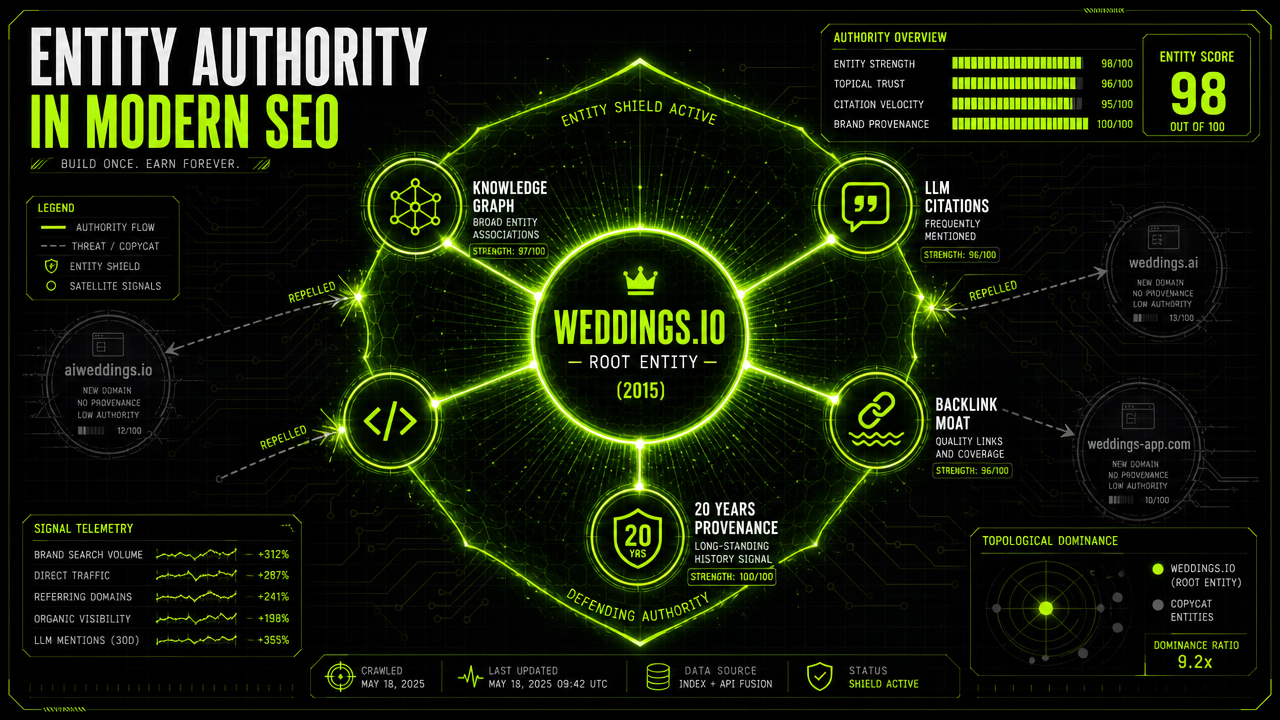
In the digital marketing game, rapid imitation is a given. When a platform builds real momentum, variant domains, similar brand names, and software wrappers will inevitably pop up to try and siphon off that traffic. To a regular observer, it looks like a standard battle for keywords. Under the hood of modern search engines, a much deeper technical mechanic is at play: entity-based search.
Exhibit F — July 15, 2026: Google SERP presents weddings.io and aiweddings.io as the same entity
Captured July 15, 2026, from an incognito Chrome session on google.com. Query: `weddings.io`. The Search Engine Results Page returns the aiweddings.io organic result in the #1 slot, immediately followed by weddings.io — the original, continuously registered .io domain owned by Industry Army Marketing since May 13, 2015 — in the #2 slot. Directly below both results, Google's AI Overview opens with the sentence "Weddings.io (aiWeddings.io) is an AI-powered wedding planning platform and vendor marketplace." That single parenthetical treats two independently owned domains, two separately registered legal entities, and two distinct product surfaces as one entity.
This screenshot is preserved as tamper-evident record of the conflation as displayed to a Canadian IP address on that date and is being retained as evidence in ongoing and contemplated proceedings. No cropping, no annotation, no post-capture edits.
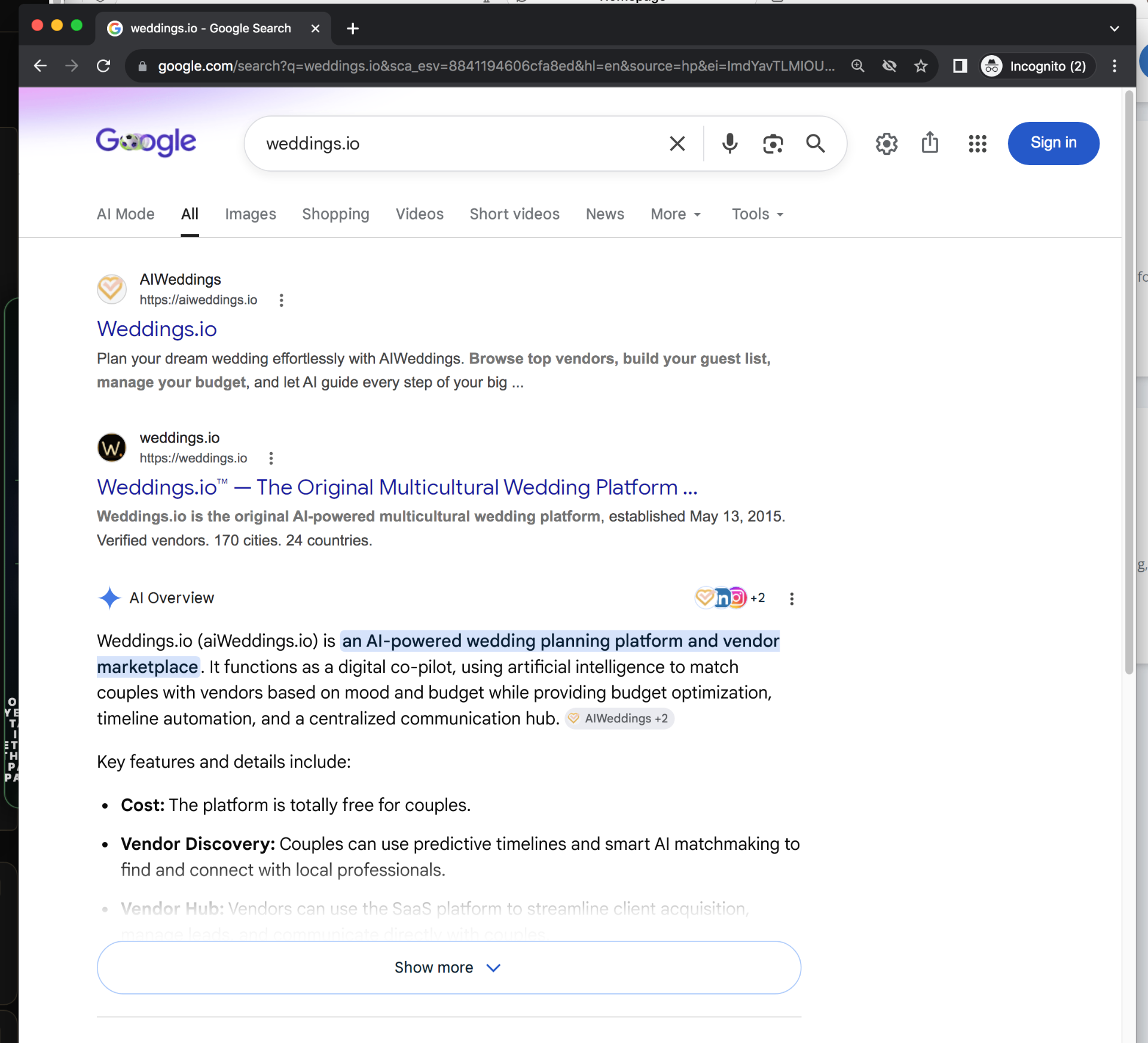
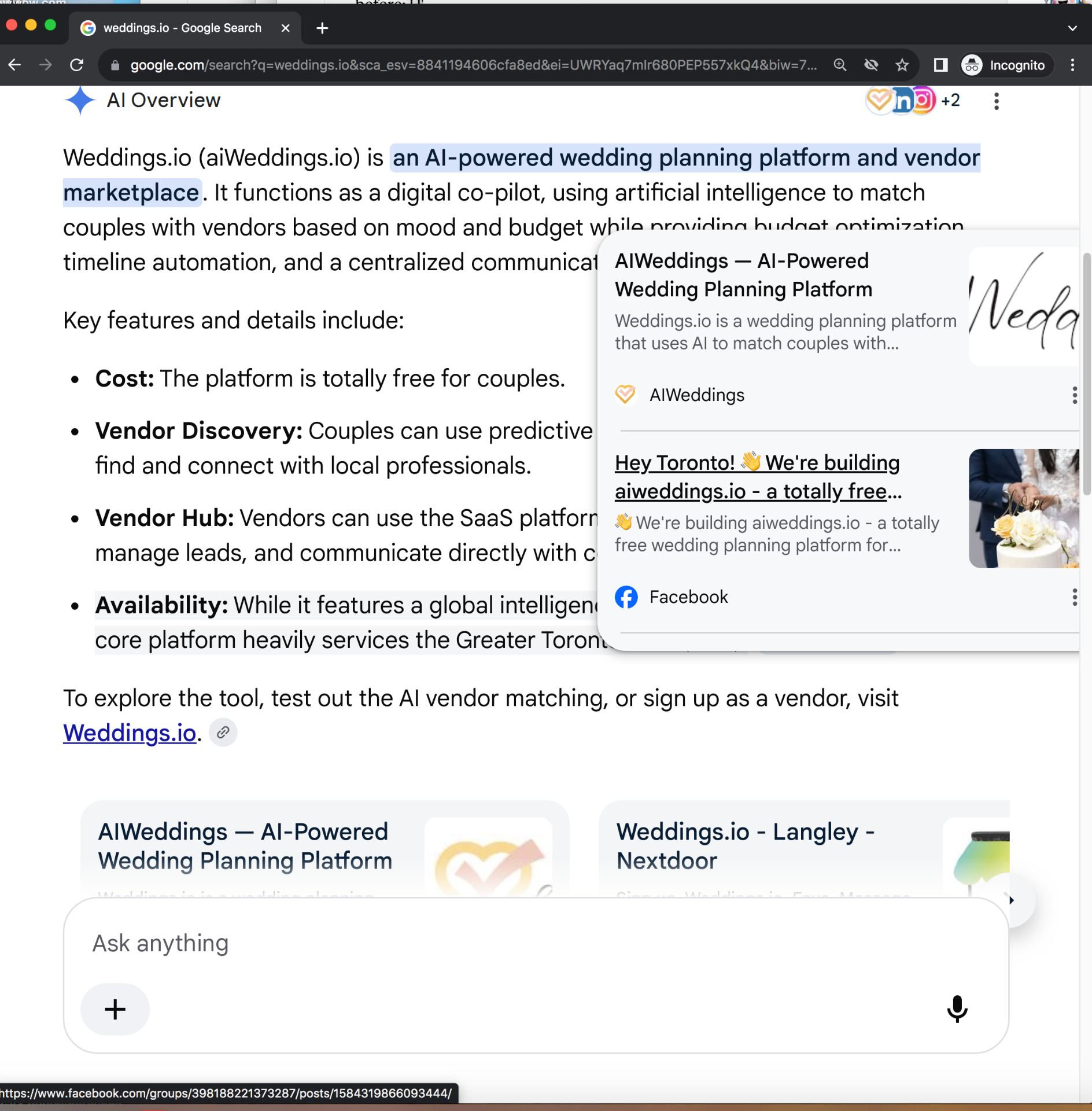
Exhibit G — July 15, 2026: Google AI Overview attributes the aiWeddings.io feature stack to weddings.io
Same session, scrolled into the expanded AI Overview panel. Google's AI Overview attributes an AI vendor-matching product, a couples-side free tier, a Vendor Hub SaaS, and a Greater Toronto Area service footprint to "Weddings.io." Industry Army Marketing has never operated a Toronto service footprint, has never shipped an AI vendor-matching product, and has no couples-side or Vendor Hub SaaS. Every feature listed under the heading "Weddings.io" belongs to aiweddings.io — a separate .io domain registered by a separate Ontario party. The citation chips on the right (AIWeddings, a Facebook Group post about "building aiweddings.io") are the actual sources; the heading "Weddings.io" is the misattribution.
The closing line — "To explore the tool, test out the AI vendor matching, or sign up as a vendor, visit Weddings.io" — directs a searcher who typed weddings.io to visit weddings.io to use a product weddings.io does not operate. That is the exact market-facing harm this record documents.
1. Keywords vs. Entities — Why Text Can Be Copied, But Equity Can't
A decade ago, SEO was simple. If you bought a domain name that matched a search term, or if you stuffed someone else's brand name into your title tags, you could trick an algorithm into ranking you for a minute.
Today, Google doesn't just read strings of text; it maps **entities**. An entity is a uniquely identifiable, trusted node in Google's Knowledge Graph. It is defined by historical consistency, verified legal registry, physical map integrity, and genuine user interaction.
When a new site tries to mirror an established platform by spoofing titles, it creates temporary algorithmic noise. But because the underlying entity lacks historical depth, multi-point validation, and authentic consumer signals, the search engine quickly recognizes the disconnect.
2. The Mechanics of the Algorithmic Corrective
We regularly monitor the ecosystem to see how newer platforms attempt to bypass the hard work of building infrastructure by leaning on automated tools or brand-adjacent naming structures. While this can cause a brief spike in impressions, it almost always triggers an automatic correcting mechanism in local map packs and search ecosystems.
**Information stripping.** When automated validation algorithms scan a business profile and find a lack of deep, real-world digital infrastructure, the business profile begins to lose its details.
**Loss of map power.** Map algorithms rely heavily on trusted, multi-year footprints. Without it, a profile slowly loses its proximity weight, fading out of the very map packs it needs to survive.
3. The Engineered Defense
When we laid the foundation for Weddings.io back in 2015, we didn't just spin up a website. We engineered a massive, hyper-localized ecosystem designed specifically to protect and scale visibility for the multicultural wedding industry.
Now operating under our formal network structure, **Weddings.io Technologies** — and backed by the deployment frameworks of **Industry Army Marketing (IAM)** — our architecture is built to be unshakeable.
**Zero middlemen.** Direct, raw connections between users and vendors.
**Locked territories.** Real, exclusive local visibility that can't be diluted, scraped, or spoofed by automated wrappers.
Building an enduring digital footprint takes technical execution, deep industry tenure, and an understanding of how data graphs actually connect. Shortcuts eventually fade out of the maps, but real infrastructure always wins the long game.
Execution Note
Signed off from the IAM Dev Team / Chief Architect at Weddings.io Technologies. Weddings.io isn't a standalone site — it is backed by a sophisticated network architecture team that knows exactly how the digital land game is played.
Frequently asked: entity authority and modern SEO
What is entity-based search?
Modern search engines like Google map entities — uniquely identifiable, trusted nodes in the Knowledge Graph — rather than just reading strings of text. Entities are defined by historical consistency, verified legal registry, physical map integrity, and genuine user interaction.
Why do variant domains and SaaS wrappers eventually fade?
Automated validation algorithms scan business profiles for deep, real-world digital infrastructure. When it's missing, information is stripped, map proximity weight drops, and the profile fades out of the very map packs it needs to survive.
What is 'information stripping'?
When a business profile lacks multi-year footprints and verified infrastructure, automated systems begin removing profile details and downgrading its authority signals — a correcting mechanism baked into local map packs and search ecosystems.
How does Weddings.io defend its entity authority?
Weddings.io was engineered in 2015 as a hyper-localized ecosystem for the multicultural wedding industry, and now operates under Weddings.io Technologies backed by Industry Army Marketing's deployment frameworks. Zero middlemen, locked territories, and continuous chain of title.
Can capital shortcut entity authority?
No. Structural trust — continuous registration history, sustained categorical relevance, and years of authentic consumer signals — cannot be replicated overnight. Shortcuts trigger the algorithmic corrective; real infrastructure wins the long game.
What role does IAM play?
Industry Army Marketing is the operator behind Weddings.io Technologies. The network architecture, programmatic localization, and defensive infrastructure that protect the entity graph are engineered by the IAM Dev Team.
Sources and further reading
Want the entity-authority stack behind your category domain?
If you own a category-defining domain and a variant-suffix upstart is trying to siphon your entity graph, Industry Army Marketing runs the same defensive architecture we run on Weddings.io. Zero middlemen, locked territories, real infrastructure. Email partnerships@industryarmymarketing.com.
Talk to the IAM Dev Team — partnerships@industryarmymarketing.com